How to identify the authenticity of Kweichow Moutai and the collection value of different versions?

Dear collectors of vintage liquors, I am a recycler from Hongkang Trading Company! Moutai liquor is legendary in the collector's market, but counterfeits abound, and judging its value is a skill. Today, let me explain in detail how to distinguish genuine Guizhou Moutai liquor from fakes, as well as the collectible value of different versions, helping you intelligently monetize your treasures!
How to distinguish genuine Guizhou Moutai liquor from counterfeit?
When it comes to the king of Asian spirits investment, Guizhou Moutai is a household name. However, the rampant counterfeiting in the market is a major problem. Based on our experience, over 70% of the Moutai on the market is fake. To ensure your Moutai is genuine, please be sure to master the following key points:
I. The primary principle for identifying genuine products
First, confirm that your Moutai is a genuine product of **Guizhou Moutai Co., Ltd.**. In addition, the condition of the packaging, the seal, the label, and the storage condition are all crucial factors affecting its value. Remember, don't rush to check prices online; the price difference between an "auction sale" and an "online bidding war" can be significant.
II. Common Methods of Making Counterfeit Alcohol
Understanding how counterfeit alcohol is made can help us find clues to its authenticity:
- Counterfeit Moutai and counterfeit brands : Some liquors imitate the common Moutai shape and use names that are easy to mislead (such as "Guizhou Moutai Town Liquor" or "Military Special Supply Liquor"). These are not produced by the genuine factory.
- Drilling holes and filling bottles (to top up the water level) : Unscrupulous merchants will drill holes in inconspicuous places such as the ribbon at the bottle neck, the dark part of the label, or the bottom of the bottle, and fill them with unknown liquor to disguise them as well-preserved old wine. This method of counterfeiting can be checked by shining a strong flashlight on the white glass bottle, which will make the tiny holes clearly visible.
- Old bottles, new packaging : Empty Moutai bottles that have already been consumed are recycled, refilled with other liquors, and then resealed. This type of counterfeit liquor typically targets Moutai from 2000 onwards, as empty bottles from that period are more common. Pay special attention to the sealing details when authenticating.
- New wine with old labels, disguised as aged wine : This involves directly replacing the labels on new wines to make them appear as vintage Moutai. Identifying this type of counterfeit wine requires extensive background knowledge of the subtle changes in Moutai wine from different periods and careful examination of label adhesion marks.
III. Identification Techniques for Moutai Liquor from Different Periods
With years of experience in Moutai authentication, Baijiulou has compiled the following key points for authenticating Moutai from different periods to help you improve the accuracy of your authentication:
-
New version of Guizhou Moutai (after 2009) :
- Hidden mark on the ribbon : Genuine Moutai liquor has a hidden number mark on the inside of the ribbon. If it appears on the outside or in an obviously incorrect position, it is a problematic liquor.
- Hidden mark on the back label : The character "酒" (jiǔ, wine) on the second line of the back label should not have its horizontal and vertical strokes connected to the strokes next to it, while counterfeit wines often have all the strokes connected.
-
The era of transparent films (1996-2009) :
- Date printing technology : On genuine Moutai liquor, the printed date should appear as complete circular particles under a high-magnification loupe, with clear ink marks ; counterfeit liquor may have irregular fonts and inconsistent ink density.
-
The period of red film sealing (between 1991 and 1996) :
- The "Maotai" lettering in the center should be slightly raised and neatly shaped. Counterfeit liquor may have the lettering recessed, crooked, or not in the exact center.
- Red film material : The red film itself should be smooth with tiny particles (similar to small bubbles). Counterfeit wine may be too rough or have no particles.
-
The old Guizhou Moutai (previously sold under a red film) :
- In 1957, the character "苔" was changed to "台" . If the character "苔" appears on the label, the chance of it being fake is extremely high, because it is very rare for Maotai liquor from before 1957 to be preserved to this day.
- The conversion from traditional to simplified Chinese characters around 1966 : After the Cultural Revolution in 1966, the Moutai Distillery changed its traditional Chinese characters to simplified Chinese characters. If a bottle of liquor produced before 1966 contains simplified Chinese characters, it can almost certainly be considered counterfeit.
- Volume adjustment in 1985 : Before 1985, Moutai was mainly sold in 540ml bottles, but afterwards it was changed to 500ml. If you see a 500ml bottle from before 1985, it is very likely a fake Moutai with new wine and old label.
The collectible value of different versions of Guizhou Moutai liquor
The value of Guizhou Moutai liquor is influenced by various factors, including vintage, scarcity, packaging integrity, authenticity, and market supply and demand. Below is a summary of market values for some classic versions, per 500ml bottle, converted to Hong Kong dollars using the exchange rate of the day (approximately 1 NTD = 0.24 HKD, 1 RMB = 1.08 HKD):
-
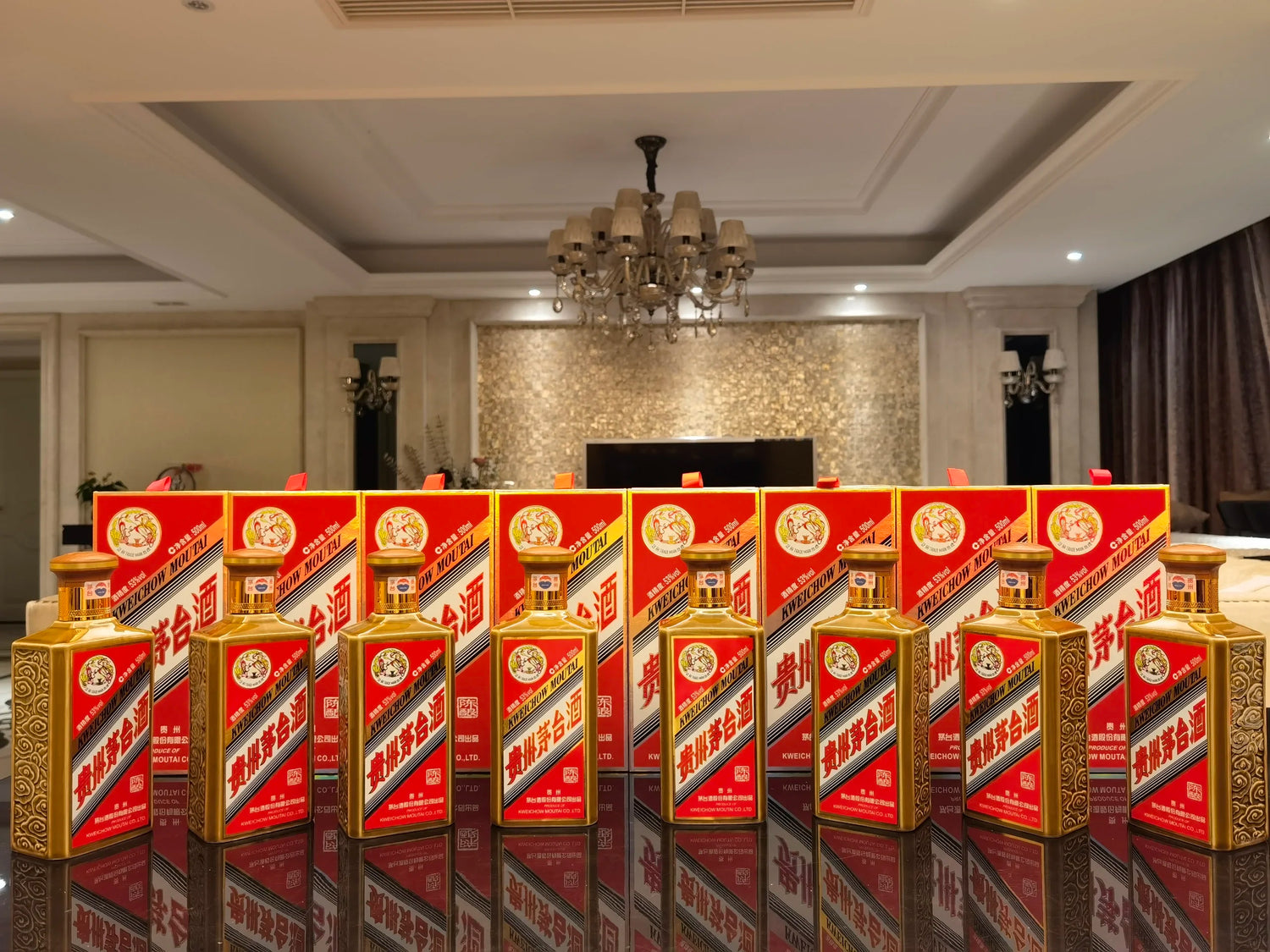
Feitian Moutai
- Old version (1996–2008) : Market transaction price is approximately NT$20,000–50,000 (approximately HK$4,800–12,000) . This is a classic export version with a large circulation volume. The early sealing and packaging are highly recognizable, the market is stable, and its value retention potential is four stars.
- Newer versions (after 2009) : Market prices are approximately NT$5,000–10,000 (approximately HK$1,200–2,400) . This version is abundant and not particularly valuable, primarily intended for entry-level collectors or short-term transactions.
-
Recent buyback price of 53-degree/500ml Feitian Moutai (for reference in the first quarter of 2025) :
- 2024 production: approximately RMB 2,200–2,400 (approximately HKD 2,376–2,592) .
- 2023 production: approximately RMB 2,600–2,800 (approximately HKD 2,808–3,024) .
- Production in 2020–2022: Approximately RMB 3,000–3,800 (approximately HKD 3,240–4,104) .
- Production from 2010–2019: Some years can reach RMB 5,000–10,000 or more (approximately HKD 5,400–10,800 or more) .
-
Five-Star Moutai with Iron Cap (1985–1990) : Market price is approximately NT$25,000–60,000 (approximately HK$6,000–14,400) . This is a classic domestically sold liquor sought after by collectors in mainland China. Those in good condition are extremely rare and are considered long-term investment assets, with a five-star potential for value preservation.
-
Sunflower Moutai (1967–1975) : Market transaction price is approximately NT$50,000–200,000 or more (approximately HK$12,000–48,000 or more) . This is a legend in the world of vintage Moutai, highly talked about, genuine products are rare, and prices have soared, but highly professional authentication is required. Its value retention potential is five stars.
-
Moutai Zodiac-themed liquors (Year of the Dragon, Year of the Tiger, etc.) : Market transaction prices are approximately NT$15,000–80,000 or more (approximately HK$3,600–19,200 or more) . Certain zodiac years, such as Dragon and Tiger, attract Asian collectors due to their cultural and investment appeal, coupled with artistic bottle designs, giving them a four-star potential for value preservation. Individual zodiac years, such as Tiger/Rabbit/Dragon, are priced at approximately NT$7,500–13,000 (approximately HK$1,800–3,120) .
-
Rare Moutai : Market transaction price is approximately NT$12,000–35,000 (approximately HK$2,880–8,400) . It enjoys recognition in the mid-to-high-end market, features unique markings on the bottle, has stable trading, and boasts a four-star potential for value preservation. Earlier pieces command higher prices, but attention should be paid to their preservation condition and the completeness of the accessories.
-
Moutai vintage wine :
- 15-Year-Old : Market price is approximately NT$9,000–11,000 (approximately HK$2,160–2,640) . Excellent quality, but the vintage labeling is somewhat controversial (not a standard for whisky), market acceptance is moderate, and its value retention potential is three stars.
- 30-year-old : Market price is approximately NT$15,000–35,000 (approximately HK$3,600–8,400) . It is rarer than the 15-year-old, has a stable price, and boasts four stars for value retention potential. However, the actual blend is not entirely made from 30-year-old base spirits, which is controversial.
- 50-Year : Market price is approximately NT$35,000–65,000 (approximately HK$8,400–15,600) . A representative of high-end Moutai, with high market demand, but beware of counterfeits. It is recommended to keep it along with the invoice or certificate of authenticity. Its value retention potential is five stars. Like the 30-Year, it is not actually blended from 50-year-old liquor.
-
Moutai Prince/Welcome Wine : Market transaction price is approximately NT$500–1,500 (approximately HK$120–360) . These are affordable versions launched by the Moutai factory, and they do not hold their value; their collectible and resale value is limited.
IV. Risks and Market Advice for Collecting Moutai
- The problem of counterfeit liquor is serious : more than 70% of Moutai on the market is counterfeit, and the methods of counterfeiting are constantly being updated.
- Preservation is not easy : Moutai liquor is easily damaged or loses its liquor. Damage to the seal, moisture on the label, or loss of liquor will seriously affect the price, even halving it.
- Market volatility and information asymmetry : While the market for Moutai in mainland China is strong, the Taiwan and Southeast Asian markets tend to favor resale for profit. Auction prices typically include extremely high transaction fees, and the actual transaction price may be less than half of the auction price.
- Controversy surrounding vintage wines : Moutai Distillery's self-interpretation of the definition of vintage wines, rather than following industry standards, undermines market trust and investment value.
As recyclers, we are well aware of both the allure and risks of Moutai. Due to the high difficulty in identifying Moutai and the lack of direct consumption and slower information reception in the Taiwanese market, Baijiulou typically advises its Taiwanese customers against holding excessive amounts of Guizhou Moutai for extended periods, to avoid unforeseen complications. Instead of investing in the unpredictable Moutai, it's better to consider popular Taiwanese whiskies or local Kinmen Kaoliang liquor, for which information is readily available.
Hongkang Trading Company, your expert in monetizing your aged liquor!
Hongkang Trading Company has been deeply involved in the vintage liquor recycling market for many years, possessing professional and accurate judgments on various versions and vintages of Guizhou Moutai, as well as market conditions. Whether you have precious Feitian Moutai, Iron Cap Five-Star Moutai, Sunflower Moutai, or any other vintage liquor, we can provide the most fair and transparent evaluation and recycling services.
Looking to liquidate your holdings of baijiu (Chinese liquor)?
Welcome to obtain professional recycling and valuation services by recycling Moutai products .
Contact Hong Kang Trading Company now to cash in on your treasured collection!
- WhatsApp: (852)94530784
📸 Feel free to send clear photos of the wine bottle (including the label, seal, and outer box) via WhatsApp, and we will provide you with a free appraisal and valuation as soon as possible!