

宏康商行
Trade Dollar One Yuan Standing Liberty | Early Silver Coin Buyback and Authentication | Hong Kang Company
Trade Dollar One Yuan Standing Liberty | Early Silver Coin Buyback and Authentication | Hong Kang Company
Deconstructing the Hong Kong Trade Dollar "Standing Dollar": Specifications, Varieties, and Market Value
To help collectors better understand their British Trade Dollars (commonly known as: Standing Dollar, Standing Man), Hong Kong Numismatic Company has specially compiled the following common information and collection guide. From coin specifications and rare years to authenticity identification, we assist you in accurately assessing the value of your collection.
1. Standard Physical Specifications of the Standing Dollar
Due to its strict minting standards, the Standing Dollar became the hard currency for Far Eastern trade at the time. Understanding its standard parameters is the first step in coin authentication.
| Parameter | Standard Data | Remarks |
|---|---|---|
| Full Name | British Trade Dollar | Commonly known as: Standing Man, Standing Dollar, Hong Kong One Dollar |
| Minting Years | 1895 - 1937 | 1935 has only trial striking patterns, extremely rare |
| Standard Weight | 26.9568 grams (approx. 26.96g) | After circulation wear, usually between 26.5g-26.8g |
| Silver Content (Fineness) | 90.0% (900/1000) | The remaining 10% is copper to increase wear resistance |
| Diameter | 39.0 mm | Edge with meander pattern (Greek fret) |
| Thickness | Approx. 2.5 mm | Slight variations depending on wear |
| Mint Mark | B (Bombay), C (Calcutta), No Mark (London) | Mark usually located centrally opposite the trident tip |
2. Valuation Factors: Year and Variety
Not all Standing Dollars have the same value. Besides condition, the mintage year and mint mark are key indicators determining the resale price of a Standing Dollar.
Analysis of Mint Marks
-
B Mark (Bombay Mint): Most common, representing the Bombay Mint in India. The mark is located in the middle of the trident tips, counting from bottom to top.
-
C Mark (Calcutta Mint): Relatively rarer, representing the Calcutta Mint in India.
-
No Mark: Mainly found in earlier years (e.g., 1895-1902), some are trial strikes from the London Mint.
Year Rarity Reference Table
| Year Category | Specific Years (Examples) | Market Attention | Collection Advice |
|---|---|---|---|
| Common Years | 1899, 1900, 1901, 1902, 1908, 1911 | Large circulation, suitable for entry-level collection or silver investment. | |
| Less Common Years | 1896 (B), 1904, 1912, 1930 | Higher market premium, good condition pieces are worth holding long-term. | |
| Rare Years | 1921, 1934, 1935 | The 1921 is known as the King of Standing Dollars, extremely rare; 1935 are mostly pattern coins, museum-grade collectibles. |
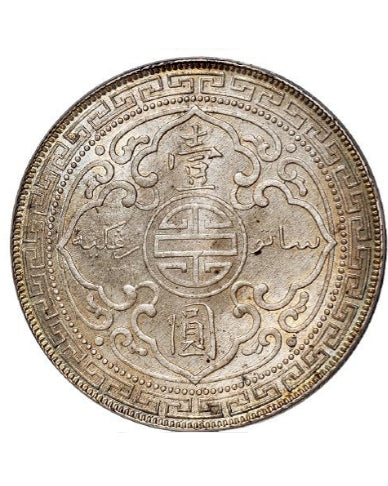
Expert Tip: The 1908 Standing Dollar shown in the image is from a year with a larger mintage, but if preserved in excellent condition (with original luster, no chop marks), its resale value is still much higher than the raw silver price.
3. Special Value of "Chop Marks"
Unlike Dragon Dollars or Yuan Datou coins, when Standing Dollars circulated in China, major money changers and banks often stamped their own chop marks on the coin surface to verify its silver content.
-
Clean (No Chop Marks): The coin surface is smooth and unmarked by circulation chops. These are usually favored by Western grading agencies (e.g., PCGS, NGC), receive high grades, and command the highest market premium.
-
Chopmarked: Although considered "blemishes," they are a testament to historical circulation.
-
Light Chop Marks: Do not significantly affect the main design (goddess, "shou" character), and have a moderate resale price.
-
Heavy/Bad Chop Marks: The coin surface is severely deformed, usually only bought for its silver value or at a low price.
-
Special Chop Marks: A very small number of collectors specifically seek Standing Dollars with special characters (such as "Fu" - fortune, "Xing" - prosperity, or bank names). These old silver coins have unique cultural artifact value.
-
4. Hong Kong Numismatic Company's Professional Authentication Process
We combine scientific instruments with traditional experience to ensure the accurate authentication of your silver coins:
-
Precision Weighing: Eliminating fake coins with severely insufficient weight.
-
Spectral Analysis: Non-destructive testing of metal element ratios to confirm 90% silver content.
-
Edge Reed Inspection: Genuine Standing Dollars have deep, strong edge reeds, while fakes often have smooth or filed edges.
-
Toning Interpretation: Distinguishing between rich, natural toning formed over time and "lustrous fake" created by chemical treatments.
Hong Kong Numismatic Company has long been dedicated to the buyback of ancient coins and early foreign trade silver dollars, with the Hong Kong Trade Dollar "One Dollar Standing Dollar" being one of our key focuses. This silver dollar originated during the late Qing Dynasty and early Republic of China period, specially minted by Britain to meet the demands of East Asian trade, and widely circulated in China, especially popular among merchants in Guangdong and Guangxi.
The Standing Dollar is renowned for its exquisite craftsmanship and high silver content. The obverse of the silver dollar features a warrior with a spear and shield standing on the shore, proudly gazing at the world. The English "ONE DOLLAR" indicating the denomination is above on both sides, with the minting year below. The reverse features the Chinese seal script character "collector item" (shou), symbolizing good fortune and longevity, with the Chinese cursive script "collector item" (yi yuan - one dollar) above and below, and the Malay "ONE DOLLAR" on either side, fully showcasing its international character as a trade dollar.
As a coin buyback institution, Hong Kong Numismatic Company possesses rich experience and an appraisal team, capable of accurately assessing the true value of Standing Dollars and providing fair and reasonable buyback quotes to clients. We warmly welcome collectors to inquire and trade, and to collectively explore the collection and investment value of Standing Dollars.
To quickly determine if your Trade Dollar One Yuan Standing Dollar early silver coin can be acquired, please provide details on toning, grading slab, obverse, and reverse. Hong Kong Numismatic Company will assess based on wear, grading, variety, and weight, and will not treat identical or similar styles as having the same price.

Common FAQs
Hongkang Commercial Recycling
-

Buyback red wine series
For many years, Hong Kang Trading has been acquiring the world's top...
-

Buyback whiskey
Three Steps to Complete a Transaction: ① WhatsApp 94530784 to send photos...
-

Buyback Moutai series
Need to clear out a house, handle an estate, or quickly convert...
-

Buyback Brandy Series
Looking to sell? Hong Kang Trading actively buys French Cognac, Armagnac, and...
-

Champagne Buyback Series
Looking to sell? Hong Kang Trading actively purchases top-tier champagnes from the...
-

Buyback Fish Maw Series
Fish maw is the dried swim bladder of marine fish, rich in...
-

Cordyceps Buyback Series
Market prices fluctuate daily, so seize the opportunity. WhatsApp 94530784 for an...
-

Buyback vinyl records
Got records to sell? Hong Kong Kong Trade buys vinyl records (LPs):...
-

Buyback Rolex series
Rolex is one of the most stable luxury brands globally in terms...
-

Buyback silver dollars/coins/commemorative banknotes series
Do you have items to sell? Hong Kang Trading Firm buys silver...
-

cigar Buyback Series
Cuban cigars (Habanos) are the standard in the cigar world, with unified...
-

Buyback Gold Series
For years, Hong Kang Trading has been purchasing real gold products: 999.9...


